Featured post

Finding your tribe

One of the most enjoyable and inspiring books I have read this year has been Sir Ken Robinson's "Out of our Minds"  and my ref...

Showing posts with label unicollaboration. Show all posts

Monday, 21 February 2022

Future Teacher 3.0: Reflecting on impact

wise owl


Image by Chräcker Heller from Pixabay


This year sees a new venture added to my retirement activities. An unexpected invitation came from the UK Future Teacher 3.0 team and this was too good an opportunity to turn down. The small UK team are an absolute powerhouse, a great example of how much can be achieved with the right blend of experience, and expertise and a shared commitment to inclusive practice in teaching. Lilian, Alistair and Ron have orchestrated monthly webinars for teachers in HE and FE since 2017 firstly as part of an Erasmus Plus funded project but now unfunded and undaunted! I have had the privilege of contributing to several sessions over the years and I really value the network and the resources they create as OERs. 

Using an open source tool called Xerte they are able to create reusable learning objects which include interactive content and are media rich and accessible. 
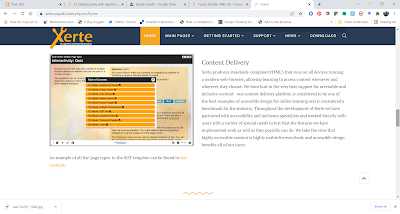

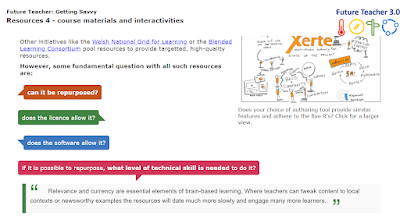
I have used the Tool Savvy resource from the 2018 webinar series several times as part of my work on tool choice for UNICollaboration and it is so good to be able to focus minds on key questions when choosing authoring tools. Xerte also means that our trainees can learn about tools whilst using one of the best examples available. 


So this is a network that lives the values of its originators, in the same way as we in #virtualexchange like to "walk the talk". So you can see why I was so excited to be asked to join the team this year. 

Of course, one of the bugbears of doing anything at the "bleeding edge" is that new tools and approaches are constantly being developed but the FT3 UK team have even turned this to an advantage! The second iteration of webinars was Reactivated -bringing new ideas to enhance the earlier recordings and this current series is Reflected, where the focus is on building upon what we have learned through reflection "because future teachers never stop learning". 

In my final years at Warwick I led a course for final year students who were considering teaching as a career. Central to my course design was both virtual exchange and reflection. We used an open source tool Mahara as a private reflection space and students were able to keep private journal posts every week which could, if they so wished, be used as part of their assessed eportfolio. This process of regular reflection incorporated into the course design helped to establish the importance of reflection to those working in time constrained and often demanding roles in teaching. Taking time to take account of how you are feeling and to, over time, develop a picture of the direction you wish to take - these things are so important in life. Sharing some of these thoughts with others can also help to strengthen your professional network and can even lead to unexpected outcomes such as new connections. 

I'm not great at sticking to routines but I do use my blogs to think things through and it has been helpful over the years. Reflecting through writing on a diary or a blog can really bring my thoughts into focus and help me find a way forward. I look forward to reading reflections from others who have been part of the Future Teacher network.


Monday, 5 February 2018

New Year, new adventures.


I spent hours on Friday and Saturday this week in Groningen - one of my favourite places. Of course, I was teaching in Warwick too so my attendance at the EVOLVE kickoff meeting was virtual but no less real.


Here you can see my colleagues: Elke, Gosia, Sake, Mirjam, Fran, Sarah, Tim, Shanon, Steve and many more. All experts in their fields, a dream team. I feel honoured to work with them. We share a commitment to a plan - to scale up virtual exchange in order to increase international understanding in a world where barriers to empathy are rife, where "America first" (insert nation of choice) has become a slogan which justifies hate speech and discrimination. 

Of course none of us in the room (whether in real life or virtually) think this will be easy. We are all experienced in the trials and tribulations of Computer Assisted Language Learning (CALL) and Computer Mediated Communication (CMC). We are nonetheless up for the challenges. This new project reaches across disciplines, it brings expertise in conflict resolution and social justice together with linguists, learning technologists, researchers and practitioners. We recognise that together we can have a greater impact. We are all heartened by the knowledge that scaling up virtual exchange is seen by the European Commission as a feasible model to support intercultural understanding and to create more cohesive societies. 

We will each be recruiting in our institutions, offering free online training and accredited participation in virtual exchanges, not just in language learning contexts but as an integral part of university curricula in order to show that academia realises the importance of global dialogue above and beyond local interests. Participation supports the achievement of SDG4  , it upholds the rights of all (including those who cannot participate in physical exchanges due to cost or personal circumstances) to engage in sustained, transformational learning experiences. To use today's tools to make the future a better place.

It's good to try to make a difference, especially when everything around you in bleak. I heard that when you are feeling at your lowest, it helps to give to someone in need. It makes the world a better place. 


Tuesday, 16 May 2017

CALLing to TELL ALL !


I have been invited to meet with trainee language teachers at the Centre for Professional Education here at Warwick this week and I will be taking the WIHEA #knowhow message with me. I will be telling my personal language teaching journey and will also attempt to demystify a bunch of acronyms. This is in order to make it easier to see the paths that exist to finding suitable networks to support their work in schools. My professional journey has involved twists and turns and sharing will I hope make it clear that the most interesting journeys can arise from indulging in a little "flâneurie".

The session will demonstrate heutagogical principles, providing a set of resources for exploration covering "old school" Computer-Assisted Language Learning (CALL), Computer-Mediated Communication (CMC), Online Intercultural Exchange (OIE), Mobile Assisted Language learning (MALL), Technology Enhanced Language Learning (TELL) and many more! Possibly the most important acronym we will meet however will be the PLN - Professional Learning Network.  Embarking on a career in teaching will leave very little time to draw breath. Connecting with others who can support and share the journey will ensure that each individual will not find themselves alone as they make their way through the challenges that lie ahead. A vital network for me when I started that journey as a Secondary School teacher to Head of Languages many years ago was the Association for Language Learning (ALL) which still is there today. Life is more complex 30 years on and the haystack we know as the internet not always the easiest place to navigate. Together we will explore the many possibilities for creation and curation. I hope I can provide a touchstone which will help to illuminate their future path.


Thursday, 19 January 2017

#BYOD4L: Thoughts on collaboration

Student created logo for the Clavier Project
As a language teacher, connecting internationally has always been at the heart of my work. My degree required a year in France (my second year was spent teaching English - mostly pop songs and popular culture) in Châteauroux, France in 1980. When I took up teaching I got involved in regular exchanges with our partner schools and accompanied the various associated trips such as the history department's visit to world war battlefields. 

In my teaching role in Higher Education I wanted to continue to give students opportunities to work on their language with real French speakers. Fortunately we have a very cosmopolitan campus and there were lots of opportunities thanks to a great student network. However, increasingly I was finding that the internet offered me lots of ways of keeping in touch with friends and trends in France and french speaking cultures. The skills I needed were relevant and I thought this provided a good way to cross formal and informal boundaries to support deeper language and intercultural understanding. I got involved in developing a virtual exchange in 2010 having met a colleague teaching in Clermond Ferrand by chance on a blog by Steve Wheeler. Explaining virtual exchange is not easy as many in HE are quite reluctant to take computer-mediated communication seriously. 

Over recent years, through my role as a learning technologist I have been able to bring my expertise in telecollaboration and computer-mediated communication to bear in a wide range of projects and collaborations. Most recently this has involved collaborating with colleague from the Open University to publish on the use of open badges in Online Intercultural Exchange (OIE) and working with colleagues from Australia (Monash) on papers to do with produsage and sustainability of teaching. I really enjoyed these collaborations, but collaborating can be very challenging. The language research community has been instrumental in producing research into the experiences of computer-mediated communication which provides great insights into success factors in this area. I am delighted that it has also now established a cross-disciplinary academic organisation to support all HE colleagues who wish to collaborate internationally called Unicollaboration. Please share the news with your telecollaborative colleagues as this will be a great way of sharing best practice and extending internationalisation in HE.