Featured post

Finding your tribe

One of the most enjoyable and inspiring books I have read this year has been Sir Ken Robinson's "Out of our Minds"  and my ref...

Sunday, 19 October 2014

Clicks and cliques

I suppose there is a human tendency to cluster around shared interests or passions. We form tribes, we are influenced by those we admire. We like connecting. We wear our group badges with pride, be they football team colours, fashions, preferred technologies, book clubs, sporting activities, on the whole we like to be one of a group or indeed several groups.Birds of a feather, flock together.

Thanks to the internet it has never been easier to seek out those who share interests. As #warcler #clerwar gets underway again the ease of # to find new friends is being put to good use. And so I have been reflecting on connectedness. 

I will be presenting next month on the many benefits of open practice and becoming a connected educator at the Global Education Conference #globaledcon14. There are so many great things that have happened in my life, so many new friends, new connections, new opportunities since I first "lurked" in online teaching spaces and I will be sharing those soon. One that is worth mentioning "en passant" is that, even when you need to down tools and take a break, someone out there is looking at your work and developing it further. Just such an event became apparent to me recently when a friend of a friend shared an image in a tweet:


Maha's diagram is a lovely re-hacking of a blog post I had written, she was quite dismissive of it, to me it was like a gift out of the blue. A connection with Egypt that I had never made before.

But do clicks make cliques? Does our participation in online groups lead to us shunning others or being dismissive of those who are outside our connections, our PLN? Do we start to use language that distances us from others, making it awkward for them to penetrate our circle? I think we must always remain aware of this danger and willing to engage widely.  

This morning I felt the need to be alone, to wander through the beautiful autumn sunshine with my thoughts. I had come across Dunbar's number a theory which maintains that humans are limited in the number of others they can connect with. I admit to feeling at times overwhelmed by the possibilities for connection and collaboration presented by the web, but I also believe that the brain is not fixed and limiting, it is flexible and complex and I wonder if this theory will stand given the new ways of working and socialising that we are witnessing online. 

As I captured some of the colour of the trees in the park I spotted chestnuts blown down by the wind, carpeting the ground and I wondered what my friends in Clermont would make of the waste of these lovely "marrons" so I will share them here. Just a few more clicks, no cliques, lots of connections.




Monday, 8 September 2014

ALT-C 2014 post conference reflections.

I always look forward to this conference and this year it was held at Warwick so it was a lovely opportunity to bring this brilliant community right to the heart of my work context. The keynotes were inspiring, the connections and presentations helpful, the sheer amount of experience and expertise in educational technology awesome. (and that's not a word I use lightly!) Since the conference finished on Wednesday however I have been mulling over my contributions. I spoke about #oie and #clavier on wed morning and Languages@Warwick development on the wed afternoon. I thought it might be helpful to summarise what I have learnt about using technologies for international interaction in a simple 5 point way for anyone who is thinking of taking this on in their own context. So here goes: 

 1. Choose your technologies carefully but choose your partners even more so! It may be almost impossible to find tech that everyone likes, but this matters not a jot if your collaborators don't trust each other. You will inevitably need to compromise on timings, activities, objectives - play the long game, agree to make progress gradually and take your teachers and students with you. If you're unhappy or resentful don't pretend everything's fine, establish clear communication right from the start and respect the opinions of others. 

 2. Connections precede collaboration. Allow time to let all participants get to know each other. Our experience shows that this is best done by proxy, that is to say carry out some tasks (profile writing,photo sharing etc) which allow the participants to discover each other without the pressure to work together immediately. If you are meeting in an online space each participant will want to build an identity in the space. Remember how you felt on arriving at the school disco or a party in a new house? You probably spent a while thinking about how to dress and then had a few drinks in the kitchen or chatted with familiar people first. 

 3. Ensure a good level of presence. There's little worse than entering an online space expecting to meet people and finding an empty space. Worse still if no-one replies to your messages. Tumbleweed moments! Plan to have sufficient "animators" in the space to welcome each new arrival and facilitate the mingling. Lead by example.

 4. Be open to ideas. Resist the urge to control everything. If people are to engage they must be given the space to make a contribution. They may want to do something you had not planned, you will not know how that will turn out unless you try it. Be flexible and generous with your time and support. 

 5. Celebrate every small win. It is important to growing the activities that you surface the impact of the activities you do. Use hard data as well as participant narratives to ensure that you have a clear picture. Communicate the findings openly and creatively so as to engage onlookers. Careful: Don't make unsubstantiated statements, that will come back to bite you! 

Collaboration is complex, see below the waterline!


Sunday, 17 August 2014

#clavier research for Eurocall 2014


Interactive representation of the data collected in the #clavier interviews


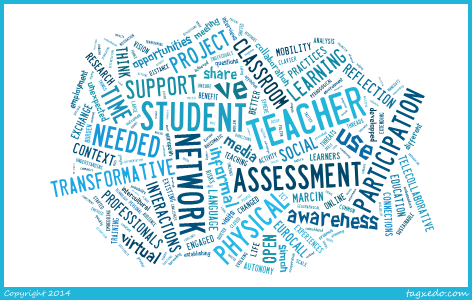
Interviews with #clavier participants aimed to establish whether there were shared understandings of the purpose of connecting tutors and students internationally. There were indeed themes that recurred. The extracts in the presentation below present the participants own voices and the image above illustrates the main themes for each question asked.

Q1: How did #clavier come about for you?
Q2: What unexpected outcomes have arisen from informal connections through social media?
Q3: Has this had a positive or negative impact on your working life?
Q4: How do you see this sort of informal network fitting into teacher development in the future?
Q5: What are the threats/opportunities/risks in your context?


Saturday, 9 August 2014

going global

Post inspired by @mrkempnz a fellow tweep and inspiring edtech educator.


Working as a teacher can be a lonely and somewhat insular occupation if you are not careful.  Whether you work in a school, a university, full time, part time or freelance you are assuming a role that puts you under the spotlight and your learners have expectations of you. Over a 30 year career I have worked in a variety of contexts with different age groups from under 10's to over 50's, one to one to one to many, responsible at some periods for the language learning of over 1,000 learners a year. I think I have a reasonable understanding of a range of learner expectations. I have definitely not "seen it all" and I learn more each year from my learners who now tend to be international students following an accelerated learning pathway to French in Higher Education. I am a co-learner with them as we explore the world of resources available to us thanks to the internet and computer-mediated communication (CMC). I try to contribute to my communities, both local and global. 

My PLN, (here's a Top Trumps I did a while back) gathered gradually over more than 5 years through interaction online, lots or reading and great networks of professionals, have broadened my outlook, inspired me to examine my assumptions more closely, to engage with debates central to my chosen career path, and to grow as an educator. Blogging and micro-blogging have helped make explicit the ruminations and half thought through ideas, reflecting and connecting in order to better understand where I stand (split infinitives are OK BTW) . Participating in synchronous and asynchronous CMC has taken me beyond the boundaries of my classroom experiences and those of my immediate colleagues into global interactions and contexts, beyond the UK and Europe. I collaborate with teachers in Australia,the US and around the world in #globalclassroom chats, extend my student connections through the #clavier virtual exchange, and explore the potential for language learning CPD through informal online networks. I have developed my use of technology for teaching, gaining a professional qualification in learning technology through the ALT CMALT scheme and now I research and publish in CMC for language learning and the emerging area of Online Intercultural Exchange (#OIE). 

I had no idea where my early tweets would lead. I followed my head and my heart and found a world of inspiration digitally enabled just a keyboard away. My students and I are the richer for it, my CPD is constant and relevant, my learning lifelong and lifewide. Connecting globally allows us to rise above the immediate, often political nature of our national context and focus on the real issues in education. We need to support the next generation as they discover the realities of sharing the planet and meeting the needs of humanity in challenging times. We promote mutual understanding, communication skills, empathy, openness and creativity. Going global has helped to reignite my passion for education.  


Wednesday, 23 July 2014

Speaking up!


The point at which I fell in love with the French language is a difficult one to pin down. Undoubtedly I was influenced by the trips my parents encouraged and the role of interpreter which they bestowed on me at just 12 years old. I was terrified of my French teacher but recently took my family to see her home town of Aix-les-Bains because I surely recognise her impact on my life. I went to Oxford Poly to study for a French degree, determined not to "do" literature but within a year I had negotiated more literary study and still have a passion for the works of Mauriac, Camus, Baudelaire, Voltaire and Prévert. (read, discussed and analysed in both my languages). I created a drama project during my PGCE around the theatre of the absurd and the works of Ionesco. Working as an assistante during the 2nd year of my first degree was no doubt a turning point though - I began to understand that language learning is not just intellectually challenging, it is fundamentally transformative - it changes the way you understand others and yourself through interaction. I continue my language learning journey through interaction largely but not exclusively online using #cmc computer-mediated communication.

My community (language teachers/experts in a variety of guises and contexts) are struggling with the realisation that young people are increasingly not choosing to continue language study for single honours degrees, numbers on such courses have been in freefall. It is very upsetting for all of us to see that the qualification we so treasure is not featuring on more wish lists and this has been the subject of countless reports, discussions and soul searching. However, the very opposite trend has been seen in university-wide language study provision so clearly young people do still enjoy the thrill of interaction across cultures. Many of them have done so all their lives but have had little or no state recognition of their linguistic heritage. At a recent school event at my university I asked a group of 14 year olds why they thought languages were useful (expecting the usual list that pointed to employability). This insight came back immediately from a young Sikh - "you can tell someone something without the others knowing what you said". Out of the mouth of babes! Language encodes, linguists decode. That is a human skill, still unmatched by google translate, requiring sophistication, knowledge and skills way beyond those which can begin to be awakened at A level, that is just the beginning. In the UK we have to send a clear message from our community that the journey may be long but it is worthwhile. In schools we need to have the freedom to inspire, in H.E. we must be relevant and move with the times.  Most importantly our community must pull together, for the losses we will sustain otherwise are too terrifying to contemplate. Valuing language skills is valuing human diversity in all its richness, and respect for life gives hope in an era of instability and war.
This post was written to relate to UCML's support for A level Content Advisory Board's recommendations. 

Saturday, 19 July 2014

It's good to talk!

This morning I moderated a twitter chat for #globalclassroom, something I participate in as often as I am able. The topic and questions are shared beforehand and I always try to collect some resources and reflect prior to the session to make it easier to keep up. When the time comes we have just one hour, lots of new people to meet and engage with and you never quite know how it will play out. 

Today's session was a subject close to my heart: how do we ensure that our learners have opportunities to develop attitudes to learning (or "habits of mind") that prepare them for the future as best we can. This is part of the role of an educator that I think is more complex than any other - the opportunity to support the acquisition of skills for life compared with simple transmission of information to pass exams. I'm not saying we don't have to do the latter, we do but it should not be at the expense of the development of the whole person. The amazing truth is we can do both well if we capitalise on the affordances of our technologies and our human creativity. 

I need to take a short digression on this topic. I didn't have time to share these during the chat. Take a look at these recent examples of discussions around this in the UK:
Tom Bennett @tombennett71 wrote this in the Guardian. I agree with his conclusion but I wish it were not framed in the usual dichotomy of facts vs skills, this is not a helpful distinction, I have blogged about before. Also this week, shared via twitter was a fabulous letter written to young learners at the end of their Primary school years showing how we can help to frame our need (parents?employers? politicians?) for measurable short term results in a wider context, that of becoming rather than being. (Interesting eh?)

Anyway, back to our #globalclassroom chat this morning. We wanted to draw out a set of global habits of mind, qualities that are necessary to interact effectively (whether as a young person or an adult) with others across national boundaries and contexts. The 16 identified here (p11) are all relevant but I would say from my experience of virtual exchanges and international telecollaboration that when languages, other cultures and technology are involved you have to take each of these to greater depths to succeed. Believe me, this is extreme HoM and deserves recognition and time to achieve within our existing educational frameworks. I await the #globalclassroom archives to see if we identify or describe others that are not simply other ways of saying what has been said already. Meanwhile I remain grateful to my international PLN and the #cmc that supports my learning for my ever expanding, rhizomatic learning happening in my home over a cup of tea and tweet deck :)

Sunday, 22 June 2014

The e word.


I chose to look at enhancement and watched the video about xMOOC models. There are several viewpoints shown in the clip but the main focus is on the Stamford experience of Udacity co founder Sebastian Thrun and his stated aim was to democratise access to learning arising from his belief that "education is a basic human right". Whilst I fully support this premise (who wouldn't ?) I felt that some of the statements made rather simplified the success of this model and at times tried to compare it to a way of teaching that would be recognised by most teachers as failing learners . Traditional teaching was presented as students sitting in ranks, not allowed to talk to each other, lecturers transmitting knowledge from the front - surely these are clichés and any institution who maintains them is already on the road to obsolescence? Sadly in HE old habits (and business plans) die hard.

The elements of the MOOC model applicable in my context:
(I prefer cMooc to xMooc personally, as I see the latter more as an institutional marketing model to support business as usual) were:


  • online delivery makes learning more accessible especially to those unable to take time away from work/life in order to study
  • greater availability of content for replay/review
  • more problem based learning, explanations afterwards, "flipped" delivery
  • increased emphasis on interaction, making best use of technology, use of quiz 
  • more economical, reach more students, make teaching a first class discipline again
  • education a lifelong issue - more relevant to modern world, flexible and continuous 
Of course all these things also apply to good blended learning. The question here is how does one scale up the tutor time in order to deliver a personalised experience to thousands of participants? It would seem from the participants interviewed that they expected to get that interaction from each other. Possibly accepted as a trade off for not having to pay to learn? One interviewee commented that we "underestimate how powerful interaction can be online". I believe that to be the case having experienced several cMoocs now since 2011. If you invest the time in online learning, getting to know your fellow learners, if the course is aligned with your personal learning needs you can indeed make useful and productive connections which can foster deep learning. Thrun's experience must be quite chilling for the established order, as it questions whether the "best" universities really select the best potential graduates, his online students outperformed those turning up on campus according to his analysis. So as I have long suspected, there is much wasted potential as a result of our industrial schooling model. 

  • problems anticipated
the business model: as soon as money is exchanged for learning a set of expectations arise which have to be met. Thrun's model implies that business as usual is required in order to fund this open free course model. Clearly new costing models would have to be established, I am sure the technology used isn't free and I guess he also expects payment for his work? This is at the heart of the issue and we need some suggestions more creative than simply trying to sell videos of experts in order to raise funds and draw attention to the institution. 

Ultimately, what is judged by learners to be "enhanced" learning opportunities will depend upon their experience of learning, not simply the content they have had access to. Interaction lies at the heart of that. Quality has never really been about institutional reputation, it is more personal than that.